Posts tagged: educational/homeschool

Geometric - String Pattern Art (Weekly Unplugged Project)

By , August 30, 2009 9:55 pm

The theme for this week’s Unplugged Project was geometric.

Inspired by this article from Family Fun we made geometric string patterns. However, not being able to resist changing instructions, we did it a little bit differently.

The article uses painted wood panels and nails. While this would certainly produce a sturdier and probably more striking result, I didn’t want to mess with sawing and painting, so I came up with a simpler alternative: foam board and straight pins.

You’ll need foam board, colored yarn, scissors, and pins.

Cut the foam board into a 12 inch square. The edges were messy so I bound them with red duct tape which actually made a nice frame.

Trace around a dinner plate onto a piece of paper to get a perfect circle. Cut out the circle. This will be your pattern for placing the pins.

Fold the paper circle in half four times and unfold. You should have 16 evenly spaced creases. Lightly tape the circle to the center of the foam board.

Stick a pin in at the top of each crease touching the edge of the circle. The pins will be sticking out pretty far, but that will give you lots of room to wrap the yarn. (NOTE: We experimented with cutting the pins in half to make them shorter, but they kept falling out and didn’t leave enough room for multiple strands of yarn.)

Remove your paper pattern and choose your yarn.

Tie the end of the yarn onto the top pin (the “12 o’clock pin”, let’s call it number 1). Create a repeating pattern and wrap your yarn. For example, moving clockwise, skip two pins and wrap around number 4, then go back to the next pin over from the “12 o’clock pin” (number 2) and wrap, moving clockwise, skip two more pins and wrap, etc. This pattern would be: 1, 4, 2, 5, 3, 6, 4, 7, etc. (NOTE: Pattern in the photo below is different, don’t get confused!)

Work all the way around the circle. When you are finished you should have a nice design. Cut the yarn and tie the end onto the last pin (should be the 12 o’clock pin).

Tie a new color onto the 12 o’clock pin and proceed with a different pattern. Any pattern at all is fine as long as it repeats itself all the way around the circle of pins. We found that three different patterns were all the pins would hold comfortably.

The article suggests putting a dab of glue on the knots. We didn’t bother, but probably would have if we had gone all out and done the wood and nails method.

My 9 year-old daughter loved this so much that she made two other little ones in the corners of her board:

My 3 and a half year-old enjoyed it too. I gave her a small piece of foam board, stuck pins in for her, and told her to do whatever she wanted.

This was the result:

She was very proud and couldn’t wait for me to take a photo!

USEFUL TIP: Remove all cats from the room. Much to everyone’s aggravation, Pita The Adventure Cat enjoyed this project tremendously:

OTHER IDEAS: You don’t have to use a circle. Try triangles, squares or rectangles. Try different numbers of pins. If you really want to get fancy, you can even make these in three dimensions!

LINKS:

++++++++++

As always, if you did a geometric Unplugged Project, then please leave the link to your actual post below. If you didn’t do a geometric project, then please do not link. You can read more about how to join in here. We’d love to have more participants!

++++++++++

The theme for next week’s Unplugged Project will be:

Ocean

Have fun and please join us!

++++++++++

Toddler Trick (so I can make dinner) - Find the Frog!

By , July 3, 2009 1:40 pm

Most parents would agree that dinner preparation is the toughest time of the day. We are worn out and the kids are tired and crabby. The easiest solution for a hard earned bit of peace is to plunk them down in front of the TV or a video in order to cook without “help” or having to play umpire.

On really bad days, I sometimes find myself too easily wanting to resort to the distraction of a video, especially with my 3 year-old who of course wants to “help” with everything, including dinner. So whenever I come across a new trick to happily and easily occupy her, I am eager to share it with others!

Several years ago I picked up some colored plastic threading and counting frogs at a yard sale. I have used them for everything from math homework to French lessons, but I just discovered a new game that my 3 year old loves: “Find the Frog!” This is proof that we don’t need something complicated or expensive (or electronic) to entertain and teach a child.

Our frog friends come in three sizes and six colors. I simply tell my 3 year-old what to thread, for example, “medium blue,” and she does it with joy! Sometimes I get fancy and say “three large orange,” or “one small red and two medium green.”

This is so simple that most of you are probably saying “Umm … what’s so special about this?” But since it never occurred to me that this game could entrance my daughter for an hour at a time, it might not have occurred to a few of you either.

Plus, consider these benefits:

  • I can work in the kitchen while playing this game with her (or be lazy and sit on the sofa and read a magazine).
  • The game teaches colors, numbers, and sizes.
  • Children practice remembering and following increasingly complicated instructions.
  • The threading is an excellent exercise of fine motor skills.
  • You could play this with almost anything that threads: beads, thread spools, colored pasta, or buttons for example. (Great for creatively repurposing household items!)
  • Variation for non-threadable items: have your child place certain items in an egg carton, container, or selection of dishware. For example: “Two blue buttons in the glass” or “One large seashell in the red bowl.”
  • Make this an activity for your “Mommy I’m Bored Box!”

For more easy ideas, please read these posts about other very simple toddler pastimes that have worked for me:

++++++++++

Hot - Edible Sugar Science (Weekly Unplugged Project)

comments Comments Off
By , August 11, 2008 7:19 pm

Finally, here is my hot post that disappeared into the ether last night. Thanks so much to Julie K in Taiwan, Angi and Nature Mama for having the brilliant idea of emailing me the post from their Google Readers. That saved me at least an hour of rewriting! I was so down on computers this morning, but this evening I am uplifted by the fact that three people I have never met in “real life” can help me out! Thank you!!! Now, on to the post:

++++++++++++

The theme for this week’s Unplugged Project was hot. Finally, we managed to get back on schedule and do it, although we broke away from our usual craft project and went in a more scientific direction.

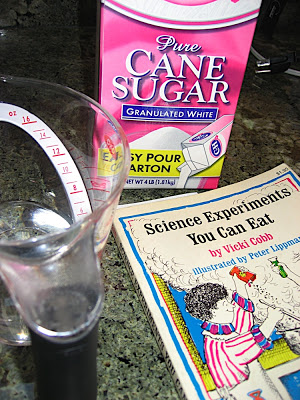
While away this summer, I found a number of good books in my Dad’s favorite thrift store (he’s a packrat too). One is called Science Experiments You Can Eat by Vicki Cobb (more about the book at the end of this post). While we were trying to come up with hot ideas, my 7 year-old daughter picked up this book and wanted to choose a food-related project. We decided on Caramel Syrup: Sugar Decomposes from the Kitchen Chemistry chapter.
Older children will find this scientifically interesting and fun to do. Younger kids will enjoy the end result!

The goal of the experiment is to teach about chemical compounds and how they can sometimes be broken down into completely different substances. Although I always liked science in school, I am not a chemist so forgive me if I am not 100% perfect in my description.

Since I am a terminal nerd, I didn’t trust the book’s very simple explanation, and actually researched sugar and how it decomposes. I learned that sugar and its breakdown process is rather complicated. (If the mysteries of caramelization keep you awake at night, then read this.)

I tried to keep it 7 year-old simple and explained to my daughter that sugar is actually carbon and water fused together. When you heat sugar, it breaks down into its original carbon and water elements. I showed her the scientific formula for table sugar (sucrose): C12H22O11 . She already new that H2O was water and could see that in the formula. After I explained that C meant carbon, she saw the carbon and water in the formula.

Heating the sugar would cause it to become watery (the release of the water) and dark (the carbon). It would no longer really be sugar.

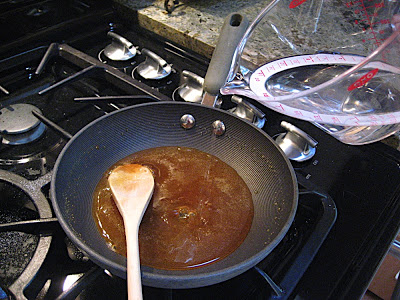
What we needed - sugar, water, a heavy frying pan:

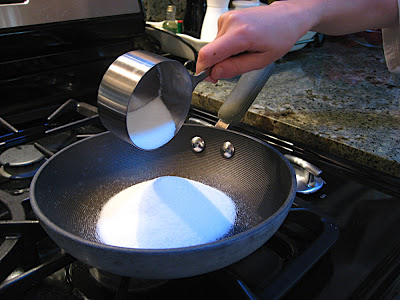
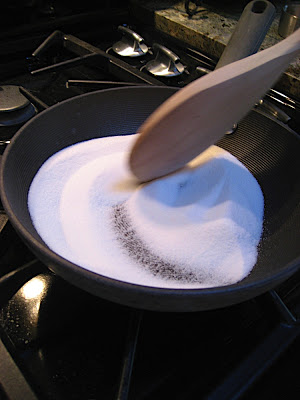
First my daughter poured half a cup of sugar into the frying pan:

We heated the sugar over medium-high heat and my daughter stirred it:

After about 5 to 10 minutes, the sugar started to melt:

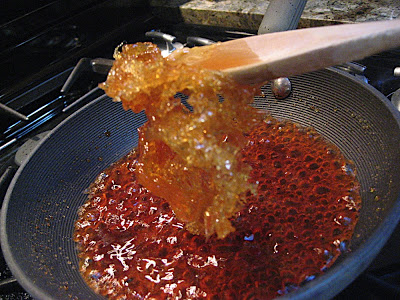
As my daughter continued stirring, the sugar melted further and began to darken and become very watery:

Finally it turned “straw-colored” and we had transformed our sugar into a new substance - caramel. We turned off the heat and slowly added half a cup of water in order to create a runny, edible solution. I did the pouring as the caramel was so hot that it steamed and spattered:

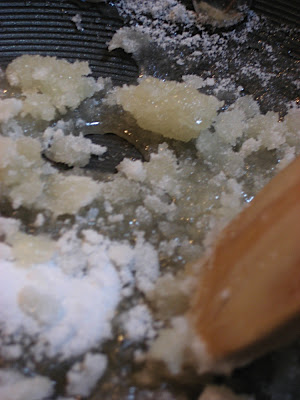
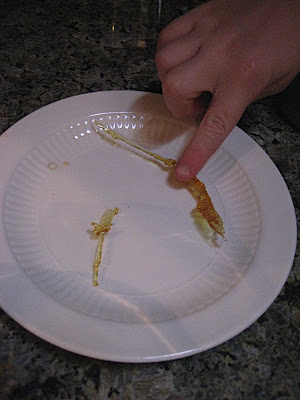
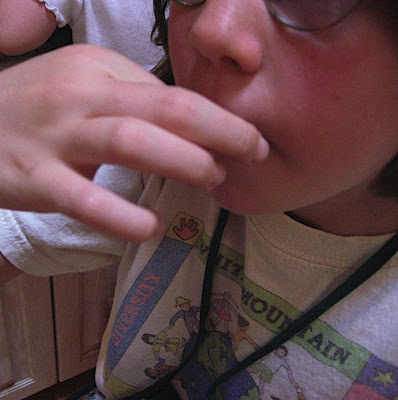
The shock-cooled caramel formed a brittle sort of candy-lump that we just had to taste:

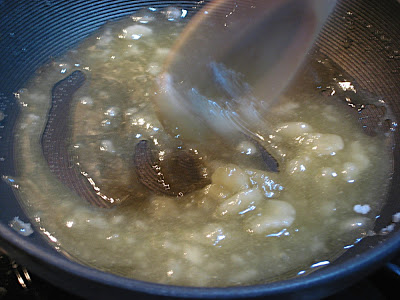
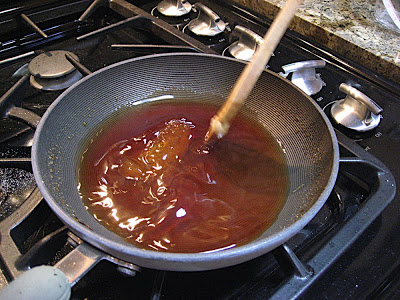
My daughter continued stirring the mixture on low heat for about another ten minutes - until the big caramel chunk dissolved into a solution:

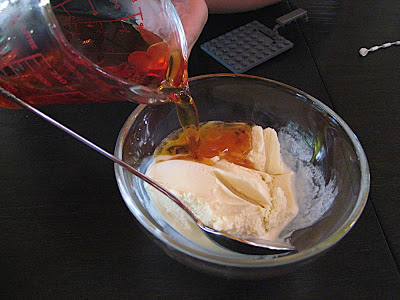
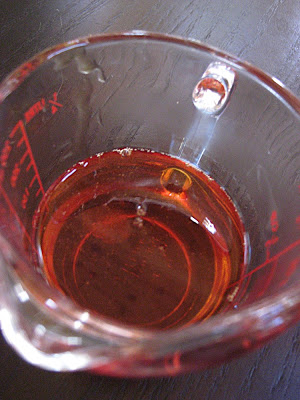
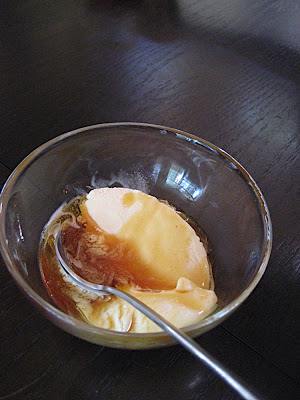
This is what we ended up with: a delicious carbon-water mixture that we ate over ice cream!

++++++++++++

If you haven’t heard of Science Experiments You Can Eat and you have scientifically-inclined children (or you homeschool), you might want to check it out of the library. Ours is an old version (1972), but the new one is supposedly revised and updated. I haven’t seen the new one, but our book has the following chapters about the science of food: A Kitchen Laboratory; Solutions; Suspensions, Colloids, and Emulsions; Carbohydrates and Fats; Proteins; Kitchen Chemistry; Plants We Eat; Microbes; and Enzymes.

+++++++++++++

If you did this week’s hot Unplugged Project, please put your link in Mr. Linky below so we can all find you. If you didn’t, please read how to join in, and consider doing next week’s project.

+++++++++++++

Next week’s Unplugged Project theme will be:

Trees

Have fun!

Sky - Constellation Star Charts (Weekly Unplugged Project)

By , July 6, 2008 9:02 pm

For this week’s Unplugged Project, sky, I was inspired by my Uncle’s very detailed star charts. He used to create charts of the constellations using thick black paper, a white pencil, and a pin to put holes where the stars were. The bigger the pinhole, the brighter the star. When you hold his charts up to the light, they are a very accurate representation of the night sky. I tried to photograph one of his charts here, but they are much easier to appreciate in person:

We gathered together astronomy books, construction paper (although dark blue was the closest we had to black), colored pencils, a ruler, and pins:

First we studied the books to find constellations that we liked. My oldest chose Leo since that is her “sign.” My 3 year-old nephew made up his own constellation, as you shall see.

Then we cut some dark blue construction paper in half. We transferred the dots to the paper as best we could by eye (if you have a simple constellation book with large drawings such as H.A. Rey’s excellent classic: The Stars: A New Way to See Them , it might be easier to trace them on tracing paper and then transfer them over to the construction paper).

The younger astronomers just drew a bunch of dots or “stars” randomly on their paper, as my 2 year-old is doing here:

They then drew lines between the stars, connecting the dots, to show the constellation forms as they do in books:

The really fun part was poking holes through each star (dot) with a pin so the light would shine through. We were not as accurate as my Uncle and did not worry about star intensities!

My 3 year-old nephew decided that his constellation was a sea horse and I can really see that! Here are the finished star charts:

And when held up to a window or light, they look like this:

++++++++++

If you joined us for sky this week, please put your link in Mr. Linky and leave a comment so we can find you. If you didn’t, you can read about how to join here.

++++++++++

The theme for next week’s Unplugged Project will be:

Stone

I hope to see you then!

Rocks (Weekly Unplugged Project) - Petroglyphs

By , March 30, 2008 7:29 pm

It has been a week full of rocks during Spring Break at our house in Albuquerque: a trip to Petroglyph National Monument, climbing over big rocks on a mountain hike, choosing pretty tumbled rocks to buy at the Natural History Museum gift shop, collecting rocks in the courtyard.

So, although I didn’t realize that we would be so into rocks this week when I chose the Unplugged Project theme last Sunday, it has been an excellent week for a rock project.

My son was too busy with his new Legos this week to care much about projects, but my oldest daughter wanted to make her own petroglyph. The children have both recently studied petroglyphs at school and I think that Petroglyph National Monument made a big impression on them.

We found what we thought would be a suitable flat rock (note: if you try this, make sure you choose as soft a rock as possible), and used a hammer to break a piece of it off to use as a chisel. We were trying to be authentic!

My daughter drew her design on the rock with a pencil. She was trying to reproduce one that we had seen at the Monument.

She then scraped the rock with the other rock to engrave the design.

Well, this proved to be slow going (the rock was not soft enough), so she got fed up and moved on to authentic Native American method number two: the Dremel Tool! My husband supervised this step and the petroglyph was quickly completed.

In case anyone is interested, here’s another fun rock idea that we once did: cracking open a geode!

Other petroglyph resources:

+ Draw your own rock art printable

+ Hawaiian petroglyphs to print and color

+ Info about petroglyphs: Petroglyphs.us

+ Fun art project: Sandpaper Petroglyphs

+++++++++++++++++++++++++++++++++++++++

If you joined us for the Unplugged Project this week, please leave a link in Mr. Linky, as well as a comment in case Mr. Linky fails at his job. If you didn’t join in, please consider taking part next week!

+++++++++++++++++++++++++++++++++++++++

Next week’s Unplugged Project theme will be:

Books

Hope to see you then!

Blog Widget by LinkWithin

Panorama Theme by Themocracy